How Residential Snow Plow Service Really Works
Curious how residential snow plow service really works? Learn about trigger depths, service options, and pet-safe de-icing to keep your home safe all winter.
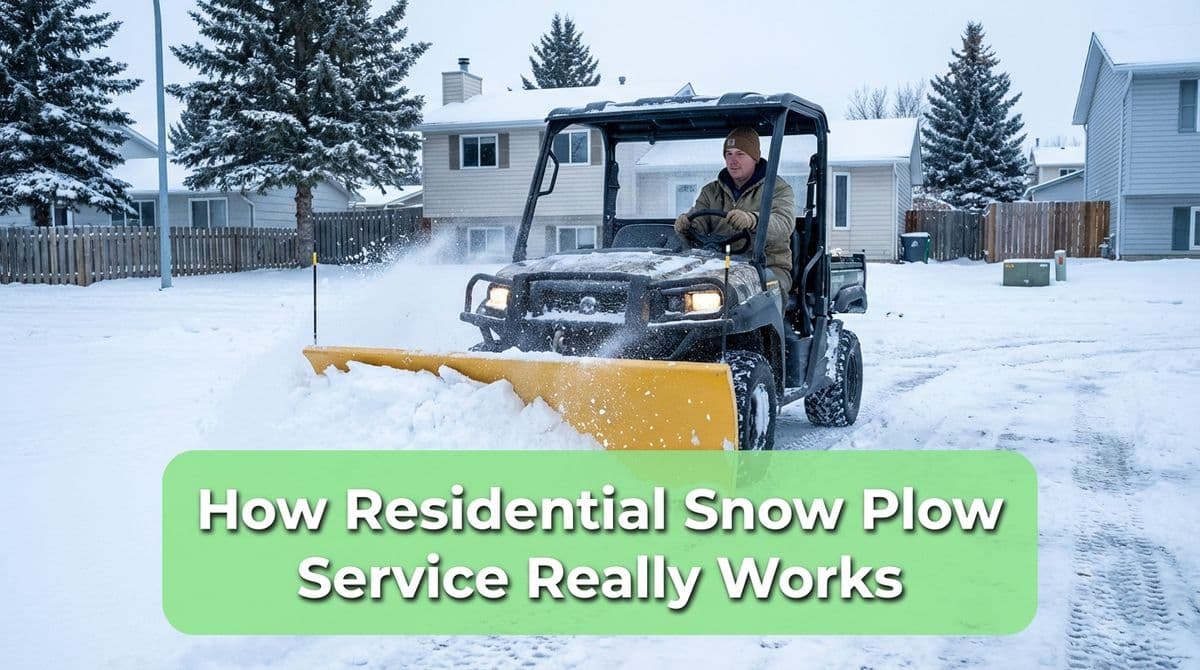
How Our Residential Snow Plow Service Really Works
We recently got a call from a homeowner — let’s call him Mark — who needed snow plow service for an upcoming storm. He had a six-car driveway on a slight incline, a walkway to the front door, and a short path to the mudroom. His main questions were simple but important: “When do you actually come out? Can I change that later? And what’s the deal with pet-safe de-icing?”
Those are the same questions we hear every winter, so I thought I’d walk through exactly how our residential snow plow service works, from trigger depths to service options and pet-safe de-icing.
Step 1: Getting Your Property Details
When you call us, we start by collecting the basics: your contact information and exactly what you want cleared — driveway, walkways, sidewalks, or all of the above. With Mark, it was:
- A six-car driveway on a slight incline
- About 15 yards of walkway to the front door
- Another short walkway to a mudroom entrance
Once we know the areas you want serviced, we measure the square footage using tools like Google Earth. That gives us an accurate size of the space we’re plowing and shoveling, so we can price it fairly and avoid surprises when the snow actually falls.
Step 2: Choosing Your Snow “Trigger Depth”
The next big decision is your trigger depth — the amount of snow that needs to fall before we automatically come out. With Mark, we walked through a few options:
- Zero tolerance: We come out for any measurable snow. Best if you need black pavement as often as possible (for example, if you leave for work very early or have mobility issues).
- 2–4 inches: A good middle ground for most homeowners who don’t mind a light coating but want it cleared before it becomes hard to manage.
- 4–6 inches: More budget-conscious. We wait until there’s a more significant accumulation. This is what Mark chose for that particular storm.
Your trigger depth basically gives us the green light. Once the forecast and our on-the-ground measurements show that total snow will hit your chosen threshold, you’re on our route for that event.
And yes, just like I told Mark, you can change that trigger later. If you start with 4–6 inches and realize you want more frequent clearing, you can call or email us to adjust it for the rest of the season.
Service Options: Per-Push vs. Seasonal Contracts
Homeowners are often unsure whether to pay per visit or sign up for a seasonal plan, so here’s how we typically explain it.
Per-Push (Per-Visit) Pricing
With per-push service, you pay each time we come out to plow and/or shovel. This worked well for Mark, who was focused on coverage for a specific big storm. Per-push is ideal if:
- You only need help for large storms.
- You don’t mind doing some light shoveling yourself for smaller events.
- You want flexibility without a season-long commitment.
Seasonal Contracts
Seasonal contracts cover the whole winter for a fixed price. We monitor every storm and come out whenever your trigger depth is reached. This is often best if:
- You want predictable costs for the season.
- You travel frequently or can’t shovel at all.
- You live in an area with frequent storms or lake-effect snow.
With either option, we spell out exactly what’s included in your contract: areas serviced, trigger depth, de-icer type, and approximate timing.
Timing: When We Plow and When We Return
During our call with Mark, we explained that we come out within 24 hours of the storm hitting his trigger depth, often much sooner. For larger storms, we may come twice:
- During the storm to open up the driveway so you can get in and out.
- After the storm ends to clean up, widen the lanes, and apply de-icer.
In bigger snow events, that “two-visit” approach keeps you from being trapped behind a wall of snow while also ensuring a cleaner finish once the storm is done.
Pet-Safe De-Icing: Rock Salt vs. Calcium Chloride
De-icer choice is another big topic, especially for pet owners. Mark mentioned he had a small dog, so we went over the two main options we offer:
- Rock salt (sodium chloride)
Effective and economical, but it can be tougher on concrete and is not very pet-friendly. It can irritate paws and, if ingested, cause stomach issues for dogs and cats. - Calcium chloride
More pet-friendly and gentler on most concrete surfaces. It also works at lower temperatures than rock salt, so it keeps walkways safer on really cold days. It does cost more, but for many pet owners, the extra peace of mind is worth it.
For Mark, the choice was easy — he opted for pet-safe calcium chloride for his walkways and entry areas. If you have pets, young kids, or older family members using the walkways frequently, we usually recommend the pet-safe option.
How We Handle Parked Cars and Tight Areas
One thing many homeowners forget to ask is how we deal with parked cars. If your driveway is full, we can only clear the accessible areas, which sometimes leaves awkward snow ridges and tight spots.
To get the best results, we recommend:
- Parking cars on the street or all on one side of the driveway before the storm, if local rules allow it.
- Letting us know about any permanent obstacles (basketball hoops, planters, low walls) so we can plan our approach and avoid damage.
- Marking the edges of your driveway with stakes so our operators can see boundaries under deep snow or at night.
For walkways and steps, we typically use shovels or snow blowers and then follow up with de-icer to reduce refreezing.
HOA, Sidewalks, and Local Rules
Before we finalize service, we also ask whether you have any HOA or municipal requirements. Some neighborhoods or towns:
- Require sidewalks to be cleared within a certain number of hours after a storm.
- Prohibit pushing snow into the street or onto neighbors’ property.
- Have rules about overnight street parking during snow events.
If you’re in an HOA, it’s smart to double-check whether they handle the sidewalks or if that’s your responsibility. We can include sidewalks in your plan if needed, but we don’t want to duplicate work you’re already paying for.
Safety Tips for Homeowners Between Visits
Even with professional plowing, there are a few simple things you can do to stay safer between our visits:
- Keep a small container of pet-safe de-icer near your front and back doors for spot-treating slick areas.
- Watch your downspouts — if they discharge across your walkway or driveway, they can create ice patches when temps drop.
- Use proper footwear with good traction, especially on inclined driveways like Mark’s.
- Don’t pile snow against foundation walls or doors, which can lead to leaks when it melts.
From Quote to “On the List”
After our call with Mark, we used aerial imagery to calculate his plowable area, set pricing based on his trigger depth and pet-safe de-icer choice, and then emailed him a simple contract. Once he reviewed and signed it electronically, we added him to our snow list for the weekend storm.
That’s the same process we use for every homeowner: clear expectations up front, a written agreement that spells out your options, and proactive service once the snow starts falling.
If you’re thinking about snow service this season, it helps to decide ahead of time on your trigger depth, whether you prefer per-push or seasonal coverage, and if pet-safe de-icer is a must. From there, we can tailor a plan that keeps your property safe and accessible all winter long.